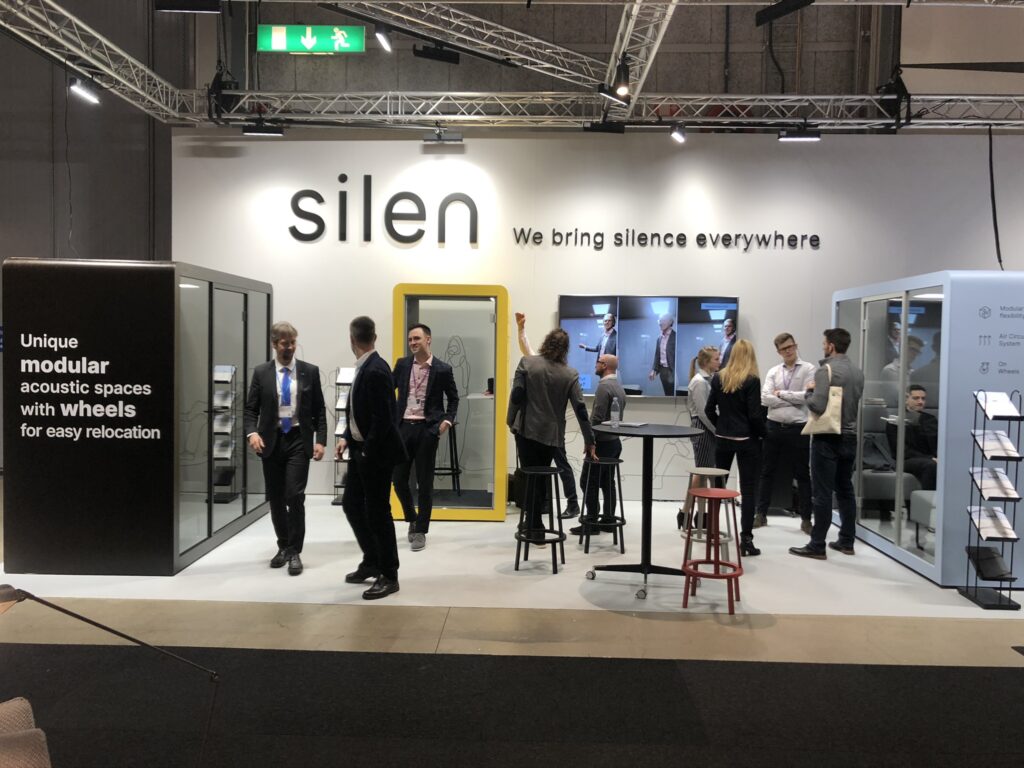
Most meetings are for two or three people. Most meeting rooms aren’t.
Walk past any UK office’s meeting rooms on a Tuesday afternoon and you’ll usually see the same thing: a ten-person boardroom holding two people, and no free other space anywhere else for the call that actually needs to happen right then.
A recent survey of 196 UK office workers by Diamond Interiors found employees spend 42% of their time in face-to-face meetings and 28% on confidential calls, meaning 70% of the work day is spent communicating rather than working alone. Offices, however, are still largely built around desks and large meeting rooms.
Contrary to what the typical office layout suggests, most meetings are small. 73% of meetings involve just one to four people. Yet, offices keep investing in large meeting rooms and open-plan collaborative spaces, even though these areas perform noticeably worse than enclosed spaces. Employees don’t want to hold private conversations in open settings where they can be overheard.
What the wrong meeting rooms are costing your business
It’s not that offices don’t have meeting rooms. It’s that they have the wrong ones. An analysis of over 30,000 meeting room records found the average office has one meeting room per 14.3 employees, but only around 3.5 in every 10 rooms are in use at any given time. Additionally, in the UK, about 30% of meeting room bookings are no-shows. Existing meeting rooms aren’t being utilised, because they’re sized for large meetings that don’t happen very often. That mismatch has a cost attached to it. Estimates suggest that UK companies lose around £10 billion a year on underutilised office space.
Small meetings need privacy, not square footage
A two-person catch-up or a confidential call doesn’t need an entire conference room. It needs a door that closes and sound-proof walls. The solution isn’t “we need more meeting rooms.” The solution is actually a cheaper one, that fully utilises the office space businesses pay for.
This is exactly the gap acoustic office pods are built to fill. A two-person Silen pod gives an office the privacy of an enclosed room, sized for the meeting that’s actually happening, without permanently committing floor space (or capital) to a boardroom that’s empty most of the week.
How acoustic office pod rental solves the sizing problem—and the cost problem
Even once you’ve worked out you need more small rooms and fewer big ones, buying is still a bet on how your team will work in three years. Hybrid patterns shift. Headcount shifts. Peak-day attendance shifts.
Renting removes that bet. With Podrent, you can rent premium acoustic office pods on a flexible term: Short, Medium or Long, from as little as three months, with installation and maintenance handled for you. If your meeting patterns change, your pods can change with them, without the sunk cost (and space) of a meeting room nobody’s booking.
The short version
How often are people in meetings?
70% of the working day is spent in meetings or calls, not at a desk.
How many people are usually in an office meeting?
Most meetings are small; 73% involve four people or fewer.
Why do offices have so many empty meeting rooms?
Around 30% of meeting room bookings are no-shows, and most offices already have enough rooms—just not the right sizes.
Is renting a meeting pod cheaper than a boardroom?
Yes. Renting small pods matches room supply to actual meeting size, without the upfront cost of building or buying.
If your meeting rooms are mostly holding two people or are underutilised altogether, it might be time to rent something built for that.
Get a Lease Quote from Podrent